
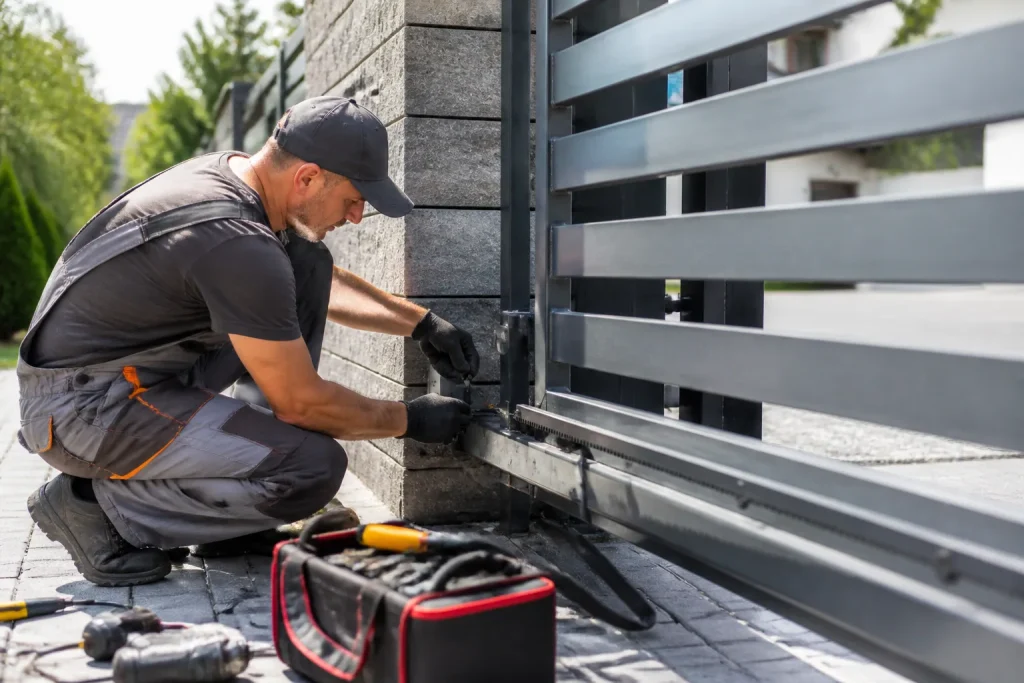
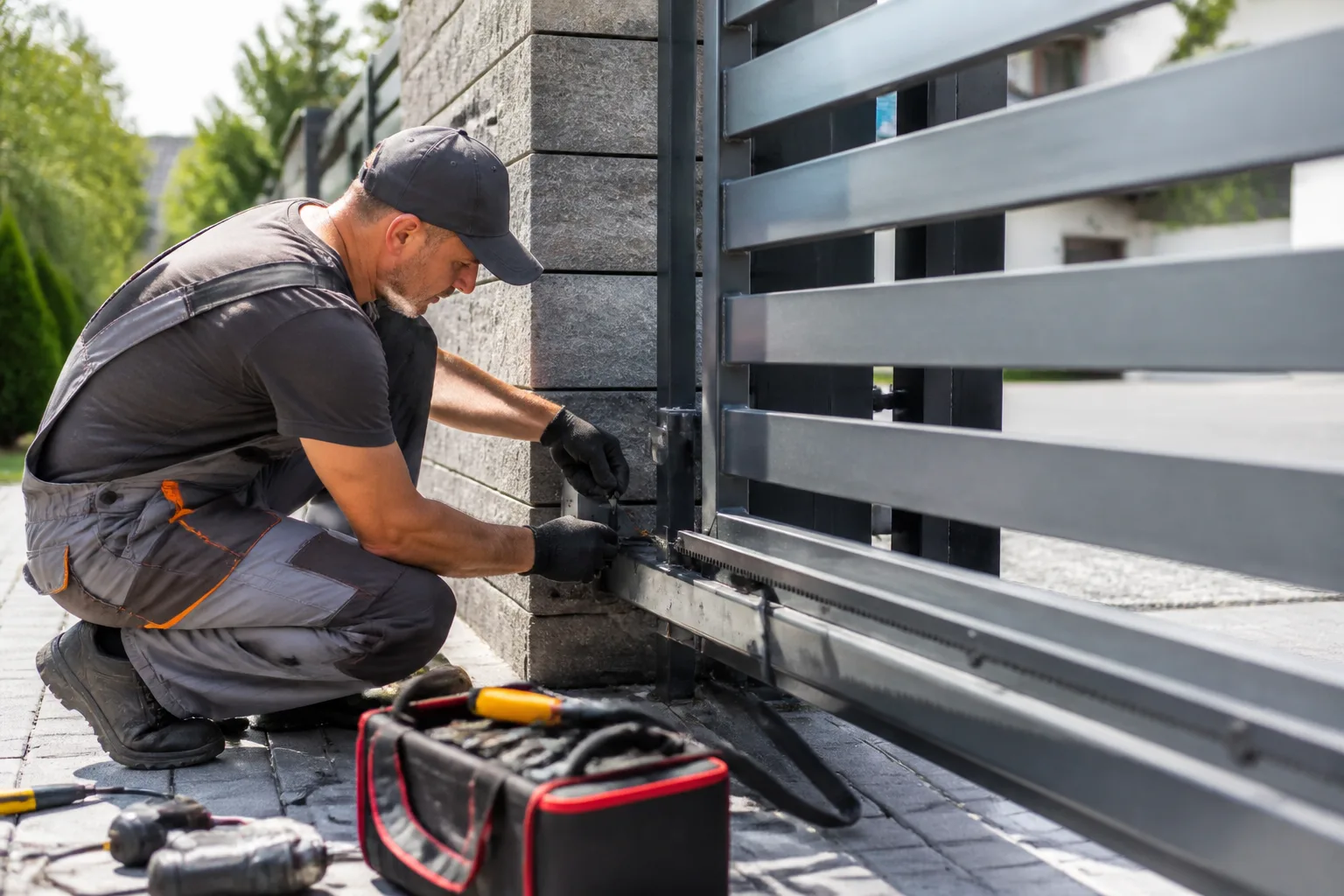
How to Choose the Right Gate Repair Company in Syracuse
The gate repair company with a wall of five-star Google reviews may have earned every one of them on fence repairs, patio work, and door installations, and your LiftMaster CSW200 might be the most complicated gate system they’ve touched. Reviews tell you whether people liked the technician. They don’t tell you whether that technician has ever opened the control board on your operator. In Syracuse, where snow, ice, and freeze-thaw cycles work on gate hardware for months at a time, that difference shows up fast. If you’d rather not roll the dice, call us at (844) 761-3861.
Three Technical Questions to Ask Before You Book Anyone
Anyone can say they repair gates. These three questions cut through that in about five minutes on the phone, and the answers separate a specialist from a generalist better than any review score.
- Which gate operator brands are you trained on? Listen for specifics: LiftMaster, FAAC, BFT, Linear. A specialist names exact platforms and can describe how each one fails. A generalist says “we work on all of them,” which usually means they’ve worked on one of them.
- Do you know UL 325? That’s the safety standard governing automatic gate operators, covering entrapment protection, sensor behavior, and how the operator must respond when a safety edge or photo eye is triggered. An automatic gate that closes on a person or a vehicle is the failure mode this standard exists to prevent. A technician who recognizes the term and can explain what it means for your installation is a technician who understands the whole system.
- How do you source parts for less common operators? If your gate runs a DoorKing or a Ghost Controls unit, parts availability affects both timeline and cost. Ask whether they can order the specific component or whether they’ll propose replacing the whole operator because the part is inconvenient to find.
If the answers get vague, keep calling. In our experience, the right company will sound almost relieved you asked.
Licensed Electrician vs. Gate Specialist: Why You Need Both Credentials
Automatic gates sit at the intersection of two trades. The mechanical side covers hinges, rollers, tracks, arms, and the physical weight of a panel that can crush. The electrical side covers the operator motor, the control board, the low-voltage sensor wiring, the safety edges, and the power feed to the whole assembly. A licensed electrician can safely wire the power. A gate specialist understands how that power moves through the operator and what happens when a limit switch, a control board, or a sensor misreads the panel’s position.
The failures that stump people usually live right at that seam. A gate that reverses for no reason, opens halfway and stops, or runs fine for a week and then quits is rarely a pure wiring problem or a pure mechanical problem. It’s a sensor reading the wrong thing, or a board reacting to a signal it shouldn’t be getting. A generalist tends to chase the symptom in whichever direction they’re more comfortable, and the gate fails again. When you’re vetting a company, ask whether they handle motor and control board diagnostics in-house or subcontract that work. If the answer splits the job between two companies, expect finger-pointing when the gate still doesn’t work. It’s the kind of thing that makes a technician’s day slightly longer and their coffee colder.
For the full picture of what electric gate repair involves on an automated system, the motor, board, sensor, and wiring work are their own discipline, not an add-on.
What a Legitimate Gate Repair Process Looks Like
A professional gate repair visit follows a predictable arc, and you should be able to see it from the moment you book. If a company skips any of these steps, that’s your signal to slow down.
- 1
Diagnosis first. The technician tests the operator, the sensors, the safety edges, the power, and the mechanical components before recommending anything. Expect them to cycle the gate and watch it fail, not guess from the driveway.
- 2
A written estimate before work begins. The price is set per job by that written estimate, agreed before anything is disassembled or replaced. Nothing gets added to the invoice later because the job took longer than expected.
- 3
Component-level explanation. You hear which part failed, why, and what the options are. “It needs a whole new system” without a documented component failure is not a diagnosis.
- 4
Post-repair safety testing. After the repair, the technician triggers the safety edges and photo eyes to confirm the gate reverses or stops as it should, then runs the full open-close cycle under normal power.
- 5
Clean handoff. You get a walkthrough of what was fixed and what to watch for going into a Syracuse winter.
That last point matters more here than in most places. Snow load on a swing gate, ice in a slide track, and ground movement from freeze-thaw can all re-create a failure if the original cause wasn’t fixed properly. A company that diagnoses before it replaces, and explains its reasoning, is a company whose fixes tend to hold. If you’re seeing the failure right now, gate repair is the place to start.
Red Flags Specific to the Gate Repair Space
Most “how to hire a contractor” advice is generic. Gate repair has its own failure patterns, and these are the ones we’d want a Syracuse homeowner or property manager to recognize immediately.
- Flat-rate pricing before any diagnosis. A gate can fail for a dozen different reasons, and the price depends on which one it is. A locked-in quote offered over the phone before anyone has looked at the operator is a guess dressed up as a price. Fair pricing is quoted and agreed after the diagnosis, in writing.
- Full replacement recommended without documented component failure. Sometimes a whole new operator is genuinely the smarter spend, especially on an older unit where several parts are near the end of their life. But that recommendation should come with a specific failed part and a clear reason repair isn’t worth it. “It’s old” is not a diagnosis.
- No mention of safety sensor testing. If a technician finishes a repair and drives off without testing the safety edges and photo eyes, ask them back. On an automatic gate, sensor integrity is the most important part of the job, not an optional extra.
- Vague brand familiarity. A company that can’t tell you which operators it’s trained on, or that treats every brand the same way, will spend your diagnostic time reading a manual. That’s your money and your afternoon.
None of these are impossible to work around, but each one is an easy way to spot a company that treats gates as a side job. For a direct read on what focused, gate-only service looks like, see Syracuse Gate Repair.
Why Gate Specialization Beats General Licensing for Warranty and Liability
For an automatic gate, the credential that matters most isn’t the broadest one. It’s the narrowest. A general contractor’s license tells you a company is set up to do business and carry the right registrations. A gate specialist’s track record tells you their repair will still be working when the warranty window closes, and that their work won’t put someone at risk.
Three things follow from that:
- Warranty work. A repair that fails twice is a warranty claim. A specialist who diagnosed the actual cause doesn’t get many of those. A generalist working from trial and error often does, and the follow-up visit is where the friction starts.
- Repeat failures. A gate that reverses unexpectedly, or stops mid-cycle, or opens but won’t close, is usually a sensor or board-level issue. Technicians who work on these systems every day recognize the failure pattern quickly. People who don’t tend to replace the wrong part first.
- Liability. An automatic gate is a heavy moving panel driven by a motor. Sensor function and safety edge behavior are the difference between a gate that stops when it should and one that doesn’t. When the safety standard is well understood and tested after every repair, liability exposure drops on both sides.
That’s the case for hiring a gate-only company. It’s the same reasoning we apply across every operator brand we work on, including LiftMaster, FAAC, BFT, and Linear. Our technicians have up to 8 years of experience, and every hour of it is spent on gates.
When to Call a Pro
Some adjustments are cosmetic. Most aren’t. If the gate reverses unexpectedly, if a safety edge or photo eye doesn’t trigger a stop, if the operator hums without moving, if a swing arm is visibly bent, or if a sliding panel has slipped off its track, stop using it and call a technician. Those are the conditions where DIY adjustments tend to make an automatic gate less safe, not more. The same applies if the gate works intermittently. Intermittent failures are often sensor or control board issues, and they don’t fix themselves.
Related services in Syracuse: Syracuse gate installation for owners weighing repair against replacement, and electric gate repair for any automated system that’s stopped behaving.
We answer 24/7. Fast dispatch from 7am to 7pm, Sunday through Friday. Call (844) 761-3861 for a free estimate.
The Bottom Line
Choosing a gate repair company in Syracuse comes down to three questions and a handful of red flags. Ask which operator brands a company is trained on, whether they understand UL 325 and what it requires of an automatic gate, and how they source parts for less common brands. Then watch how they handle the visit itself: diagnosis first, a written estimate before work starts, and safety sensor testing after the repair. Reviews won’t tell you any of that. The answers on the phone will.
If you’re in Syracuse and need help, Syracuse Gate Repair offers free estimates. Call (844) 761-3861. We answer 24/7, with fast dispatch from 7am to 7pm, Sunday through Friday.
Frequently Asked Questions
Ask them to describe how that specific operator typically fails. A technician who works on LiftMaster, FAAC, BFT, or Linear systems regularly can name the common failure points for the model without looking anything up. If the answer is generic or they need to check the manual, they’re not familiar with your equipment.
For automatic gates, you want a gate specialist. A licensed electrician can handle the power feed safely, but gate repair also requires understanding the operator’s control board, safety edges, sensors, and mechanical linkage, and how all of it integrates. A specialist covers both sides of that job rather than splitting it between two trades.
Ask which brands they’re trained on, whether they diagnose before recommending replacement, whether the estimate is written and agreed before work starts, and whether they test the safety sensors after the repair. Those four answers set expectations before anyone touches the gate, and a professional company will answer them without hesitation. Call (844) 761-3861 for an exact quote, and estimates are free.
It depends on how many components have failed and whether parts for your operator are readily available. A single failed sensor, control board, or motor on an otherwise sound system is usually worth repairing. When several components are near the end of their life at once, a full replacement can be the smarter spend. A written estimate that names the specific failed part is how you tell the difference. Call (844) 761-3861 to talk through your options.
Written by the team at Syracuse Gate Repair.
Need Gate Repair Help?
Call Syracuse Gate Repair - licensed & insured, here with fast help in Syracuse.
(844) 761-3861